
Experience
Tokushima
Encounter Awa Indigo's “Japan Blue” at Ai no Yakata in Aizumi
Tokushima
Encounter Awa Indigo's “Japan Blue” at Ai no Yakata in Aizumi
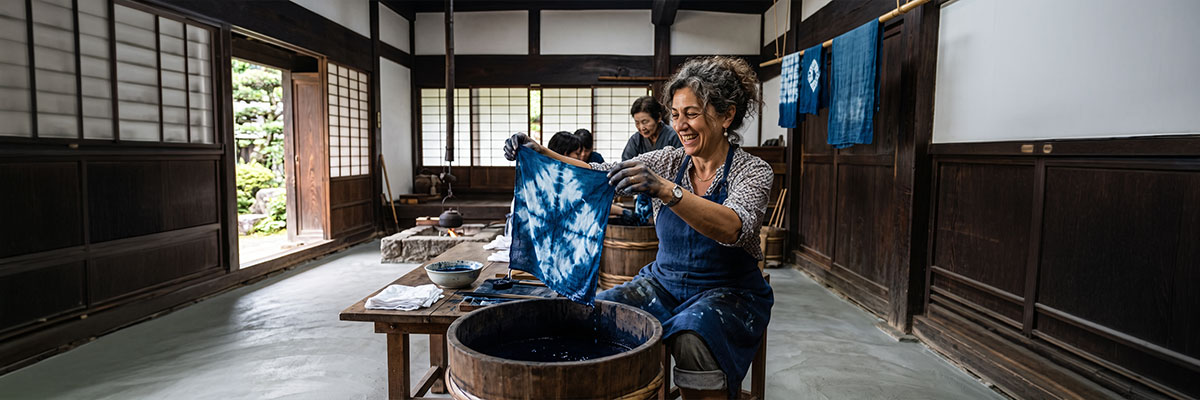 This image was generated using AI. The actual experience may differ from what is shown.
Overview
The Yoshino River basin in northern Tokushima sustained Japan's dyeing culture with Awa indigo during the Edo period. By the 1700s, Awa indigo dominated the national market. Its production techniques were designated a Selected Conservation Technique by the Japanese government in 1978, and the region's story was recognized in 2019 as the Japan Heritage site “Awa – The Birthplace of “Japan Blue.” The Aizumi Town History Museum "Ai no Yakata" occupies 13 preserved buildings from the estate of the Okumura family, great indigo merchants who made their fortune through the dye. The main house, built in 1808, and other structures are designated Tangible Cultural Properties by Tokushima Prefecture. As you explore the estate and exhibition hall, you can try authentic indigo dyeing with a vat prepared by the traditional lye-fermentation method known as aku-hakko-date.
Highlights
Lower white cloth into an indigo vat, then pull it out and expose it to the air: the greenish fabric quickly deepens into blue. Witnessing this oxidation-driven transformation with your own hands is the greatest surprise of authentic indigo dyeing.
-
Dye not in an exhibit, but where indigo merchants lived and worked.
The former Okumura estate has 13 buildings around a courtyard, including the main house, storehouses, and the nedoko indigo-processing workshop. Even the west reception room, where out-of-prefecture business partners were entertained at banquets, survives as vivid evidence of the indigo merchants' prosperity. The dyeing experience takes place in the nedoko. Use rubber bands or boards to create patterns on a handkerchief or stole, and in about 30–40 minutes you will have a unique piece. Individuals need no reservation; allow roughly 1.5–2 hours for the experience and a tour of the estate and exhibition hall.
-
Discover why Awa indigo dyed all Japan—and why it nearly vanished.
Dioramas and videos in the exhibition hall trace the story from indigo cultivation nourished by the Yoshino River, through the making of sukumo fermented indigo-leaf dye, to distribution across Japan. Soon after production peaked in 1903, large-scale imports of synthetic indigo from Germany caused a rapid decline. Yet indigo masters preserved their craft, and the Yoshino River basin remains Japan's leading producer of sukumo today.
-
Easy to pair with the starting point of the pilgrimage.
Ai no Yakata lies in the same lower Yoshino River area as Ryozenji, Temple No. 1 and the “temple where the pilgrimage begins.” Local sightseeing-taxi itineraries commonly combine the two. Before or after taking your first steps on the route, why not experience the Japan Blue born from Shikoku's climate and landscape?
Information
Prices, services, and booking procedures are current as of the time of writing and are subject to change.
- Nearest Temple:
- Ryozenji, Temple No. 1 of the Shikoku 88-Temple Pilgrimage (Oasa-cho, Naruto), a short drive away
- Duration:
- Indigo-dyeing experience: approx. 30–40 minutes (allow approx. 1.5–2 hours together with the estate and exhibition hall)
- Price:
- Indigo dyeing: handkerchief ¥1,000; bandana, tenugui hand towel, and similar items ¥1,500; silk stoles ¥2,000–¥3,500; other items also available. Admission charged separately (adults ¥300; junior high/high school students ¥200; elementary school students ¥150).*As of September 2026; Ai no Yakata official website and Tokushima Prefecture's official tourism website
- Language:
- English brochure available (an English page is also available on Tokushima Prefecture's official tourism website)
- Booking:
- No reservation required for individuals (experience reception 9:00 a.m.–3:30 p.m. on opening days; closed Tuesdays and during the New Year holidays). Groups of 10 or more and visitors bringing their own fabric must book in advance.