
Glossary
Ohenro Glossary
This category brings together the ideas and values that illustrate how people have
perceived their way of life and the afterlife, and have found spiritual solace, with
Buddhism and Shinto-Buddhist syncretism as their background.
Concepts such as
salvation, virtue, the afterlife, and nirvana have been passed down as fundamental
ideas that underpin the meaning of pilgrimages and religious practice.
- Amida Buddha (Amida Nyorai)
- The Buddha of Infinite Light and Life, ruler of the Pure Land. Believed to guide those who recite his name into paradise after death. One of the most widely venerated Buddhas in Japan.
- Salvation (Kyūsai)
- The act by which a Buddha or Bodhisattva removes suffering and guides sentient beings toward enlightenment and peace.
- Merit (Kudoku)
- Spiritual benefit accumulated through good deeds and religious practice. Believed to bring blessings in this life and the next.
- Worldly Benefits (Genze Riyaku)
- Concrete blessings received in this life through prayer and practice, such as recovery from illness or success in business.
- Kobo Daishi (Kukai) (Kōbō Daishi (Kūkai))
- A Buddhist monk of the Heian period (774–835) and founder of Shingon Buddhism in Japan. The Shikoku pilgrimage traces the sites of his ascetic training, and pilgrims believe he walks alongside them throughout the journey.
- Rebirth in Paradise (Gokuraku Ōjō)
- The Buddhist aspiration to be reborn in Amida Buddha's Pure Land after death, achieved through devotion and the recitation of Amida's name.
- Sacred Tree (Goshinboku)
- A tree believed to be inhabited by a deity or divine spirit. Considered sacred and often found within shrine precincts.
- Mountain Worship (Sangaku Shinkō)
- An ancient Japanese belief that reveres mountains as sacred places inhabited by gods and spirits. Deeply intertwined with Buddhism and Shugendo practice.
- Faith (Shinkō)
- The act of believing in and placing one's trust in the Buddha, gods, or other transcendent beings. The spiritual foundation of all religious practice.
- Shingon Buddhism (Shingon-shū)
- A school of esoteric Buddhism founded in Japan by Kukai (Kobo Daishi) in the Heian period. Centered on Vairocana Buddha, it seeks enlightenment through mantra, ritual, and mandala.
- Syncretism of Shinto & Buddhism (Shinbutsu Shūgō)
- The fusion of Shinto and Buddhism, where deities of each tradition were identified with one another. This uniquely Japanese worldview shaped temples and shrines for over a millennium.
- Ji Sect (Ji-shū)
- A Pure Land Buddhist sect founded by Ippen in the Kamakura period. Known for spreading nembutsu (Amida chanting) through ecstatic dancing and chanting events.
- Jizo Bodhisattva (Jizō Bosatsu)
- A Bodhisattva believed to travel through the six realms of existence to save all beings. Particularly venerated as protector of children and travelers, and often found along pilgrimage roads.
- Zen (Zen)
- A school of Buddhism that emphasizes direct experience of one's true nature through meditation, particularly seated meditation (zazen), rather than ritual or scripture.
- Soto Zen (Sōtō-shū)
- A major Zen school introduced to Japan by Dogen in the Kamakura period. Emphasizes 'just sitting' (shikantaza) as the practice itself, integrating training into everyday life.
- Great Teacher (Daishi) (Daishi)
- An honorific title bestowed upon eminent Buddhist monks. In the context of the Shikoku pilgrimage, it almost always refers to Kobo Daishi (Kukai).
- Vairocana Buddha (Dainichi Nyorai)
- The cosmic Buddha symbolizing the truth of the universe itself. The central deity of Shingon Buddhism and the source of all Buddhas.
- Tendai Buddhism (Tendai-shū)
- A school of Buddhism established in Japan by Saicho in the Heian period. Centered on the Lotus Sutra, it embraces all teachings as one comprehensive path to enlightenment.
- Nirvana (Nehan)
- The ultimate state of peace and liberation, completely freed from suffering and earthly desires.
- Bishamonten (Bishamonten)
- One of the Four Heavenly Kings and guardian of the north. Revered as a god of war, protection, and fortune, granting treasure and victory to devotees.
- Fudo Myo-o (Fudō Myō-ō)
- A wrathful deity who severs earthly desires with a sword and rope. Especially revered in Shingon Buddhism as a powerful protector of practitioners.
- Buddhism (Bukkyō)
- A religion originating in India around the 5th century BCE with the teachings of Shakyamuni (Siddhartha Gautama). It teaches the path to liberation from suffering through the pursuit of enlightenment.
- Benzaiten (Benzaiten)
- A goddess of music, arts, and fortune, and one of the Seven Lucky Gods. Originating from the Indian goddess Sarasvati, she is widely venerated across Japan.
- Principal Object of Worship (Honzon)
- The central Buddha or Bodhisattva enshrined in a temple and most highly venerated there.
- Enlightenment (Bodhi) (Bodai)
- The state of awakening in Buddhism — the ultimate spiritual realization toward which all Buddhist practice aspires.
- Esoteric Buddhism (Mikkyō)
- A branch of Buddhism that seeks enlightenment through mantra, ritual, and mandala. In Japan, represented primarily by the Shingon tradition introduced by Kukai.
- Wisdom Kings (Myō-ō)
- Wrathful deities acting on behalf of the Buddhas to protect sentient beings. With fierce appearance, they strike down earthly desires and guide beings onto the right path.
- Maitreya Bodhisattva (Miroku Bosatsu)
- A Bodhisattva believed to appear in the future to save all beings. Also called the 'Future Buddha.'
- Manjushri Bodhisattva (Monju Bosatsu)
- The Bodhisattva of wisdom and discernment. Grants correct judgment and learning success, often depicted riding a lion.
- Medicine Buddha (Yakushi Nyorai)
- The Buddha of healing, formally known as Yakushi Rurikō Nyorai. Widely venerated for curing illness and granting good health and longevity.
- Afterlife (Raise)
- The next life or world one is reborn into after death, according to Buddhist cosmology.
- Arhat (Rakan) (Rakan)
- A person who has attained enlightenment through the Buddha's teachings. The ideal of religious practice, typically depicted as a disciple of Shakyamuni.
- Rinzai Zen (Rinzai-shū)
- A Zen school introduced to Japan by Eisai. Emphasizes paradoxical koans and direct exchanges with a master to achieve sudden enlightenment.
- Divine Miracle (Reigen)
- A wondrous effect or blessing believed to manifest through the power and grace of Buddhas and deities.
- Sacred Wood (Reiboku)
- Wood or trees believed to contain spiritual power, revered as objects of faith.
- Ohenro (Shikoku Pilgrimage) (Ohenro)
- The pilgrimage to the 88 sacred temples of Shikoku associated with Kobo Daishi, or the pilgrims who make this journey.
- Ascetic Practice (Kugyō)
- Intense spiritual training that involves enduring physical and mental hardship to cut off earthly desires and draw closer to enlightenment.
- Completion of the Pilgrimage (Kechigan)
- The state of having completed all temples in the pilgrimage circuit and fulfilled one's vow. The final stage of the journey.
- Mountain Ascetic Training (Sangaku Shugyō)
- Rigorous spiritual training conducted in the mountains, using the natural environment to forge both body and mind.
- Spiritual Training (Shugyō)
- Religious practice aimed at spiritual growth and the attainment of enlightenment through disciplining body and mind.
- Shugendo Practice (Shugen)
- The practice of Shugendo, a tradition blending mountain worship and Buddhism. Performed in harsh natural environments to acquire spiritual power.
- Pilgrimage (Junrei)
- The act of traveling to sacred sites or holy grounds based on religious devotion.
- Two Traveling Together (Dōgyō Ninin)
- The belief that even when walking alone, Kobo Daishi is always beside you — that you are always traveling as two. A fundamental principle of the Ohenro pilgrimage.
- Henro Korogashi (Difficult Pass) (Henro Korogashi)
- Particularly steep or treacherous sections of the pilgrimage route, so difficult that pilgrims might tumble and fall.
- Awakening of Aspiration (Hosshin)
- The resolve to enter the Buddhist path and awaken the aspiration for enlightenment. The spiritual starting point of the pilgrimage.
- Osamefuda (Name Slip) (Osamefuda)
- A slip of paper on which pilgrims write their name, address, and wishes, then offer at each temple as proof of their visit.
- Prayer (Kigan)
- The act of praying to a Buddha or deity for a specific wish to come true.
- Sharing Merit (Kudoku Gaeshi)
- The practice of sharing spiritual merit gained from one's own practice with others, including those who have passed away.
- Memorial Service (Kuyo) (Kuyō)
- A ritual offering prayers and making offerings for the repose of the deceased or to honor objects that have been used.
- Goshuin (Temple Seal) (Goshuin)
- A stamp or seal obtained at temples and shrines, combined with hand-brushed calligraphy, as proof of one's visit.
- Goma Fire Ritual (Goma)
- An esoteric Buddhist ritual in which offerings are burned in sacred fire to purify earthly desires and pray for specific intentions.
- Sutra Recitation (Gongyo) (Gongyō)
- The regular recitation of sutras and prayers as religious practice.
- Temple Visit (Sanpai)
- Visiting a temple or shrine to worship and pay respects.
- Sutra Copying (Shakyo) (Shakyō)
- The practice of hand-copying Buddhist sutras as a form of meditation and religious devotion.
- Mantra (Shingon)
- Sacred words or phrases used in esoteric Buddhist rituals. Reciting mantras is believed to connect the practitioner directly with the power of the Buddha.
- Settai (Pilgrims' Hospitality) (Settai)
- The custom of local people offering food, drink, lodging, or money to pilgrims as an act of generosity. It is considered an offering to Kobo Daishi himself.
- Takuhatsu (Alms Round) (Takuhatsu)
- The practice of monks walking through town carrying a bowl to receive food offerings from the community.
- Sutra Chanting (Dokyo) (Dokyō)
- The act of reading aloud from Buddhist sutras as a devotional practice.
- Nokyo (Temple Stamp) (Nōkyō)
- The act of offering sutras at a temple and receiving a verification stamp. An essential ritual for Ohenro pilgrims at every temple.
- Nokyo-in (Stamp) (Nōkyō-in)
- The official stamp received from a temple verifying that a pilgrim has completed sutra recitation there.
- Heart Sutra (Hannya Shingyō)
- One of the most important sutras in Buddhism, recited by Ohenro pilgrims at every temple. It encapsulates key teachings on the nature of emptiness and reality.
- Almsgiving (Fuse) (Hodokoshi / Fuse)
- The offering of food, money, or goods to monks or pilgrims. A core practice in Buddhism for cultivating generosity and compassion.
- Kyahan (Leg Wraps) (Kyahan)
- Traditional cloth wrappings worn around the lower leg and foot during long-distance walking on the pilgrimage road.
- Kyohon (Sutra Book) (Kyōhon)
- A booklet containing the Buddhist sutras recited at each of the 88 temples on the pilgrimage.
- Kongozue (Pilgrim's Staff) (Kongōzue)
- The wooden walking staff carried by Ohenro pilgrims. It symbolizes Kobo Daishi himself and is treated with deep respect throughout the journey.
- Juzu (Prayer Beads) (Juzu)
- Buddhist prayer beads used during sutra recitation and devotional practice. Typically held in the hands during worship.
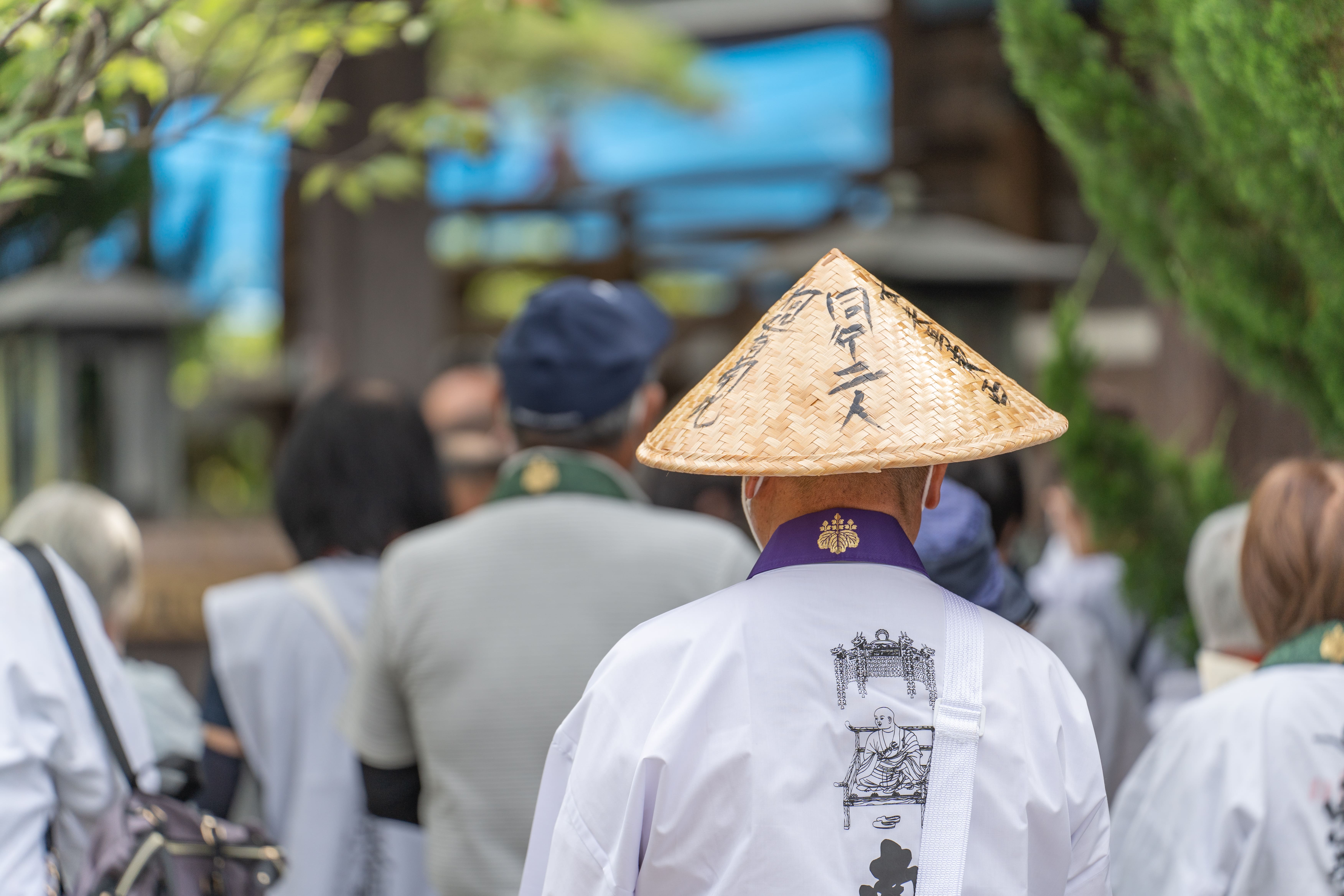
- Sugegasa (Sedge Hat) (Sugegasa)
- The traditional conical hat made of sedge grass worn by Ohenro pilgrims. Inscribed with the phrase 'dōgyō ninin' (two traveling together).
- Nokyo-cho (Stamp Book) (Nōkyō-chō)
- The book in which pilgrims collect stamps and calligraphy from each of the 88 temples. A treasured record of the pilgrimage.
- Hakue (White Robe) (Byakue)
- The white robe worn by Ohenro pilgrims, symbolizing purity and readiness to face death. Also associated with burial shrouds.
- Wagesa (Short Stole) (Wagesa)
- A simplified Buddhist stole worn around the neck. Used by lay pilgrims as a symbol of devotion during the pilgrimage.
- Stone Steps (Ishidan)
- Stone stairways leading up to temples. Many pilgrimage temples have long, steep stone staircases that must be climbed to reach the main hall.
- Covered Corridor (Kairō)
- A roofed walkway connecting the various buildings within a temple complex.
- Kannon Hall (Kannondō)
- A hall dedicated to Kannon Bodhisattva (Guanyin), the Bodhisattva of Compassion and Mercy.
- Scripture Repository (Kyōzō)
- A building within a temple complex used to store Buddhist scriptures and texts.
- Temple Grounds (Keidai)
- The entire precincts of a temple, including all its buildings, gardens, and sacred grounds.
- Kokubunji (Provincial Temple) (Kokubunji)
- Temples established throughout Japan by Emperor Shomu in the 8th century as official state temples for each province. Several appear among the 88 Shikoku pilgrimage temples.
- Five-Story Pagoda (Gojū-no-Tō)
- A five-tiered pagoda symbolizing the five elements of Buddhist cosmology: earth, water, fire, wind, and sky. A landmark of traditional temple architecture.
- Three-Story Pagoda (Sanjū-no-Tō)
- A three-tiered pagoda, a common variation of the traditional pagoda form found at Japanese temples.
- Approach Path (Sando) (Sandō)
- The path leading from the temple gate to the main hall. Walking the sando is part of the ritual of approaching the sacred space.
- Temple Gate (Sanmon) (Sanmon)
- The main gate of a temple complex, marking the boundary between the secular world and the sacred grounds.
- Temple Lodging (Shukubo) (Shukubō)
- Lodging facilities within temple precincts where pilgrims can stay overnight and may participate in morning sutra services.
- Study Hall (Shoin) (Shoin)
- A formal reception hall or study room within a temple, often featuring traditional shoin-style architecture.
- Bell Tower (Shōrō)
- A structure housing the temple's large hanging bell. Pilgrims often ring the bell upon arriving at a temple as an offering.
- Jizo Hall (Jizōdō)
- A hall dedicated to Jizo Bodhisattva, the guardian of travelers and children. Common along pilgrimage routes.
- Shinto Shrine (Jinja)
- A place of worship in the Shinto religion. Due to the historical fusion of Shinto and Buddhism, shrines are often found within or adjacent to temple precincts.
- Stone Buddha (Sekibutsu)
- A Buddha or Bodhisattva image carved in stone. Found along roadsides and in temple grounds as objects of veneration and waymarkers.
- Tahoto Pagoda (Tahōtō)
- A distinctive type of pagoda with a cylindrical body topped by a square base and dome. Associated with esoteric Buddhism and Shingon temples.
- Daishi Hall (Daishidō)
- A hall dedicated to Kobo Daishi (Kukai). Found at every Shikoku pilgrimage temple, it is one of the two main structures pilgrims must visit and offer prayers at.
- Stone Lantern (Tōrō)
- A traditional lantern made of stone, used to light temple and shrine precincts. A characteristic element of Japanese sacred architecture.
- Torii Gate (Torii)
- The traditional gateway marking the entrance to a Shinto shrine. Symbolizes the transition from the mundane world to the sacred.
- Niomon Gate (Niōmon)
- A temple gate flanked by two fierce guardian statues (Nio) that protect the temple from evil spirits.
- Nokyo Office (Nōkyōjo)
- The temple office where pilgrims receive their nokyo stamp and calligraphy in their stamp book.
- Worship Hall (Haiden)
- The front hall of a shrine used for worship and ceremonies, situated before the inner sanctuary.
- Fudasho (Pilgrimage Temple) (Fudashō)
- One of the 88 official temples of the Shikoku pilgrimage circuit, each associated with Kobo Daishi and having a designated principal object of worship.
- Buddha Footprint Stone (Bussokuseki)
- A stone engraved with an image of the Buddha's footprints. Venerated as a representation of the Buddha's living presence.
- Benten Hall (Bentendō)
- A hall dedicated to Benzaiten, the goddess of music, arts, and fortune. Often found near water.
- Treasure Hall (Hōmotsukan)
- A museum or storehouse within a temple complex displaying religious artifacts, artworks, and temple treasures.
- Main Shrine Hall (Honden)
- The innermost and most sacred building of a shrine, housing the deity. Generally not open to the public.
- Main Hall (Hondo) (Hondō)
- The principal hall of a Buddhist temple, housing the main object of worship. Together with the Daishi Hall, it is one of the two essential stops for Ohenro pilgrims at every temple.
- Sacred Site (Reijo) (Reijō)
- A place believed to have special spiritual power or divine presence, often the site of miraculous events. All 88 temples of the Shikoku pilgrimage are reijo.
- Emperor Kanmu (Kanmu Tennō)
- Emperor of Japan (r. 781–806), who moved the capital to Kyoto (Heian-kyo) in 794. An important patron of early Japanese Buddhism who supported Saicho and Kukai.
- Gyoki (Gyōki)
- A Buddhist monk of the Nara period (668–749) who traveled throughout Japan building roads, bridges, and temples. Regarded as a bodhisattva-like figure by the common people.
- Kuya Shonin (Kūya Shōnin)
- A wandering Buddhist monk of the mid-Heian period (903–972) who spread the recitation of Amida's name among the common people, earning the name 'Saint of the Market.'
- Emperor Shomu (Shōmu Tennō)
- Emperor of Japan (r. 724–749), a devout Buddhist who ordered the construction of Todai-ji and provincial temples (kokubunji) throughout Japan.
- Tankei (Tankei)
- A master sculptor of the Kamakura period (1173–1256), son of the renowned Unkei. Created several important Buddhist statues housed at pilgrimage temples.
- Toyotomi Hideyoshi (Toyotomi Hideyoshi)
- The powerful warlord who unified Japan (1537–1598). Had a significant impact on Buddhist institutions of his time through his complex relationship with temples and shrines.
- Myoe (Myōe)
- A Buddhist monk of the Kamakura period (1173–1232) who sought to revive the precepts of Buddhism. Known for his rigorous practice and deep veneration of the Buddha.
- Emperor Monmu (Monmu Tennō)
- Emperor of Japan (r. 697–707), who played an important role in establishing the legal and administrative framework of the early Japanese state.
- Anti-Buddhist Movement (Haibutsu Kishaku)
- The suppression and destruction of Buddhism carried out in the early Meiji period (late 1860s–1870s) as part of a government policy to separate Shinto from Buddhism and establish Shinto as the state religion.
- Meiji Restoration (Meiji Ishin)
- The political revolution of 1868 that restored imperial rule in Japan and set the country on a path of rapid modernization and Westernization.
- National Treasure (Kokuhō)
- The highest designation for culturally significant properties in Japan, granted to objects of exceptional historical and artistic value.
- Historic Site (Shiseki)
- A location designated by the government for its historical significance, including ruins, old roads, and archaeological sites.
- Important Cultural Property (Jūyō Bunkazai)
- A government designation for buildings, artworks, and other items deemed important to Japan's cultural heritage.
- Natural Monument (Tennen Kinenbutsu)
- A plant, animal, or geological feature designated for protection due to its scientific or cultural significance.
- Special Historic Site (Tokubetsu Shiseki)
- A higher-tier historic site designation for locations of exceptional historical or cultural significance.
- Scenic Beauty (Meishō)
- A place designated for its outstanding natural or cultural landscape beauty.