
Experience
Experience the charm of Shikoku.
-
 Tokushima
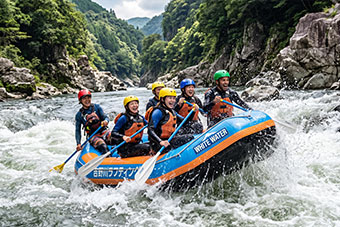
Raft a World Championship River with an English-Speaking Guide: Whitewater Adventure through Koboke Gorge on the Yoshino River
Near the center of Shikoku, the Oboke and Koboke gorges stretch along the middle reaches of the Yoshino River in Miyoshi, Tokushima, carved through exposed Sanbagawa metamorphic rock. Designated a National Natural Monument in 2014, this gorge is one of Japan's premier whitewater destinations and hosted the 2017 World Rafting Championships, which brought together 71 teams from 22 countries. Go Go Adventure is a rafting tour operator based on this stretch of river and a member of the Japan Rafting Association. With free transfers from JR Awa-Kawaguchi Station and service in English, international visitors can reach the experience entirely by rail. Tours operate each year from April through November.
View more -
 Tokushima
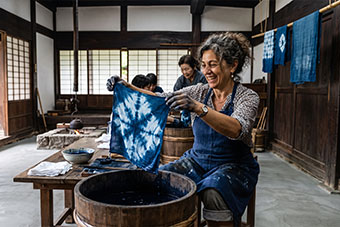
Create a Unique Indigo Piece in a Great Indigo Merchant's Estate: Encounter Awa Indigo's “Japan Blue” at Ai no Yakata in Aizumi
The Yoshino River basin in northern Tokushima sustained Japan's dyeing culture with Awa indigo during the Edo period. By the 1700s, Awa indigo dominated the national market. Its production techniques were designated a Selected Conservation Technique by the Japanese government in 1978, and the region's story was recognized in 2019 as the Japan Heritage site “Awa – The Birthplace of “Japan Blue.” The Aizumi Town History Museum "Ai no Yakata" occupies 13 preserved buildings from the estate of the Okumura family, great indigo merchants who made their fortune through the dye. The main house, built in 1808, and other structures are designated Tangible Cultural Properties by Tokushima Prefecture. As you explore the estate and exhibition hall, you can try authentic indigo dyeing with a vat prepared by the traditional lye-fermentation method known as aku-hakko-date.
View more -
 Ehime
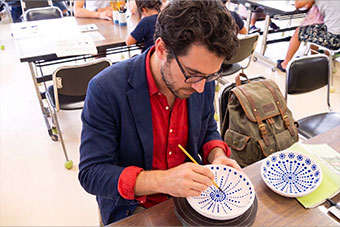
EhimePaint Indigo on White Porcelain: Turn 250 Years of Craftsmanship into Your Own Piece in the Home of Tobe Ware
Tobe, just south of Matsuyama, is a porcelain-producing town with around 250 years of Tobe ware history. The craft is said to have begun in 1777, when potter Josuke Sugino successfully fired white porcelain using discarded whetstone fragments, once a local specialty, as raw material. Today, around 100 kilns remain in the area. At the Tobe Ware Traditional Industry Hall in the heart of town, historical materials and masterpieces offer a complete introduction to the craft. Nearby, the municipally run Tobe-cho Ceramics Creation Center offers walk-in pottery-painting experiences, while the ceramic promenade known as the Path of Ceramic Panels lets you absorb the atmosphere of the pottery district in a single day.
View more -
 Kagawa
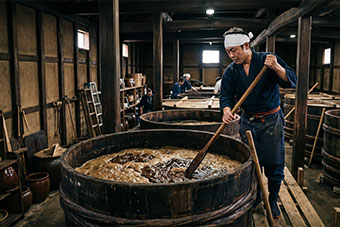
Taste Japan's Living Fermentation Culture with All Five Senses: 150-Year-Old Wooden Vats Still at Work at Yamaroku Soy Sauce on Shodoshima
Shodoshima is one of Japan's leading soy sauce-producing regions, with a history spanning around 400 years. Yamaroku Soy Sauce, founded roughly 150 years ago, stands in a corner of Hishio no Sato ("Soy Sauce Village"), where more than 20 soy sauce breweries and tsukudani factories still line the streets. Its moromi fermentation warehouse, built in the early Meiji period and registered as a National Tangible Cultural Property, continues to ferment soy sauce in giant cedar vats (kioke) that have been in use for over 150 years. Anyone can visit this living brewery free of charge, with no reservation required.
View more -
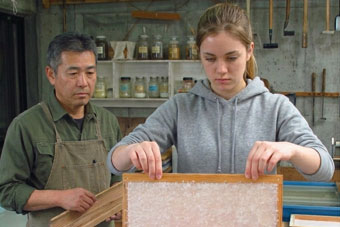 Tokushima
Awa Washi: Create Your Own Paper Along the Yoshino River――A 1,300-Year-Old Craft Tradition
Located in Yamakawa, Yoshinogawa City, Tokushima Prefecture, the Awa Washi Traditional Industry Hall preserves the heritage of Awa Washi, a traditional Japanese paper with roots dating back to the Nara period. Designated as both an Intangible Cultural Property of Tokushima Prefecture and a Traditional Craft of Japan, Awa Washi has a history spanning approximately 1,300 years. According to the Kogo Shūi (古事拾遺, 807), the Imbe clan (忌部族) cultivated hemp and mulberry trees and began producing paper and textiles in this region. Visitors can observe skilled artisans demonstrating the traditional hand-papermaking process and even create their own postcards or calligraphy paper through hands-on workshops.
View more -
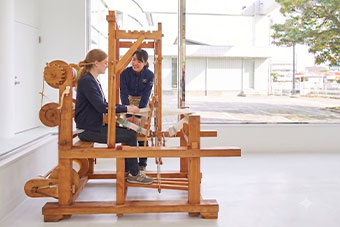 Ehime
EhimeWeave, Test, and Personalize Experience World――Class Quality in the Home of Imabari Towels
Imabari City in Ehime Prefecture is Japan’s largest towel-producing region. Its towel industry has a history of more than 120 years, dating back to 1894. Since 1960, Imabari has continued to hold the top position in Japan in terms of towel production value.Located in the city center, Texport Imabari is home to the official Imabari Towel flagship store and the hands-on Imabari Towel LAB. Visitors can try the famous “five-second rule” absorbency test, experience towel weaving on a handloom free of charge, and have purchased towels embroidered with their names. It is a place where visitors can take home a one-of-a-kind towel.
View more -
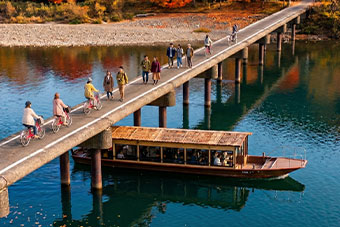 Kochi
KochiDrifting Beneath the Bridges of Japan’s Last Clear Stream A Houseboat Journey on the Shimanto River
The Shimanto River is the longest river in Shikoku, stretching 196 kilometers. Because there are no large dams on its main stream, it is widely known as “Japan’s last clear stream.”In 1993, Kochi Prefecture decided to preserve the submersible bridges of the Shimanto River basin as part of the region’s living cultural heritage. In 2009, the landscape of the river basin, including these bridges, was designated an Important Cultural Landscape of Japan.A journey by roofed houseboat offers a quiet and distinctive way to experience the river. As the boat moves slowly across the water, visitors can view the famous chinka-bashi (沈下橋)—bridges without railings, designed to sink beneath the water when the river rises—up close.
View more -
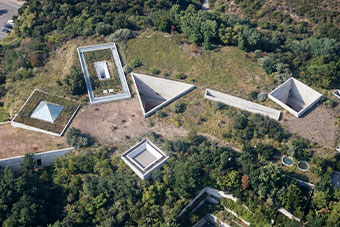 Kagawa
After Completing the Pilgrimage Encounter Monet’s Water Lilies in the Light of Chichu Art Museum, Naoshima
Chichu Art Museum is located on Naoshima, an island in the Seto Inland Sea, at 3449-1 Naoshima, Kagawa District, Kagawa Prefecture. It opened on July 18, 2004, as a place for contemplating the relationship between nature and humanity. Designed by architect Tadao Ando, the museum is built mostly underground so as not to disturb the beautiful landscape of the Seto Inland Sea. Its greatest feature is that, although it is underground, natural light pours into the museum. As a result, the artworks and the surrounding spaces change subtly depending on the time of day and the season.The museum permanently displays works by three artists: Claude Monet, James Turrell, and Walter De Maria. It is operated by the Fukutake Foundation and is one of the major facilities of Benesse Art Site Naoshima.
View more -
 Tokushima
Embark on an Art Pilgrimage at a Ceramic Museum in Shikoku Where the World's Masterpieces Gather
Located in Naruto Park in Naruto, Tokushima Prefecture, the Otsuka Museum of Art is one of Japan's largest museums of masterpieces faithfully reproduced at their original size on ceramic boards.
View more -
 Kochi
KochiDiscover Japan's Botanical World in the Mountains of Shikoku— Half a Day at the Kochi Prefectural Makino Botanical Garden
The Kochi Prefectural Makino Botanical Garden is a comprehensive botanical garden opened on Mount Godai in Kochi City in 1958 to honor the achievements of Dr. Tomitaro Makino, the botanist known as the “father of Japanese plant taxonomy.”
View more -
 Ehime
EhimeVisit the Home of Imabari Towels— See an Everyday Essential Come to Life on a Shichifuku Towel Factory Tour
Founded in 1959, Shichifuku Towel is an Imabari manufacturer that handles every stage in-house, from planning and design to production and inspection.
View more -
 Kagawa
Create a Palm-Sized Landscape in the Home of Bonsai— A Miniature Bonkei-Making Experience at Takamatsu Bonsai Village
The Kinashi and Kokubunji area of Takamatsu, Kagawa Prefecture, is renowned as a major production center responsible for about 80% of Japan's pine bonsai.
View more